Search This Blog

Thursday, May 10, 2012

Parashat Emor: How to be a Priest


Leviticus is the biblical book rabbis do not want you to read. Saturated with sacrificial minutiae and unsettling descriptions of ritual impurity, its countless sheep and goat offerings seem a more effective salve for insomnia than any woe that pains the heart. After all, what do wave offerings or incense recipes have in common with more substantive things, like wireless Internet or the smell of freshly brewed java in the morning?

Yet the reason why studying Leviticus is so often neglected is not because it seems boring or embarrassingly regressive. Au contraire; study of Leviticus is neglected because its contents are so revolutionary and radical that we fear giving the book anything more than a dutiful glance.

This week’s Torah Portion, Emor, begins with a command to the priestly caste that they avoid all contact with the dead, the exception being close relatives and kin. “And the Lord said unto Moses: Speak to the priests, the sons of Aaron, and say unto them: There shall none defile himself for the dead among his people” (Leviticus 21:1-2).

The law is in keeping with the general obligation that priests maintain the requisite strictures of purity and holiness. Indeed, the Sons of Aaron have already been warned not to serve in the Tabernacle while drunk (Leviticus 10:9); and they are given further rules prohibiting self-mutilation as well as strict limits about whom they can wed (Leviticus 21:4-7).

Yet if we think about this command a moment longer, it should strike us as being extraordinarily counterintuitive. The priests — Kohanim — are meant to be the spiritual leaders of Israel. Their sacred task is “to distinguish between holy and unholy, between impure and pure and to teach the children of Israel all the statutes which the Lord has spoken unto Moses” (Leviticus 10:11). They are in essence the clerical heads — the rabbis — of the people. And yet, here they are expressly forbidden from officiating or even participating in perhaps what is one of the most trying and difficult of lifecycle events — the Jewish funeral. In almost all cases, they are banned from preparing the body for burial or even accompanying the family as they escort the departed to its final resting place. It seems fair to ask why this is so.

The Italian sage, Rabbi Ovadia Sforno (1475-1550), suggested that since it is the task of the priest to give honor and glory to God, it would be a grave violation of his charge to use his station to give honor to the dead (Sforno, Leviticus 21:5.6).

More recently, modern scholars have pointed to the immense chasm between the practices of ancient Egypt and those of Israel. In contrast to Israel, Egypt’s priests made funerary rites and rituals the single most important aspect of their religion. Embalming, mummification and numerous ceremonies accompanied entombing. To appreciate the centrality of Egyptian burial rites, consider that the pyramids were not built for the living, or think back to how Joseph was embalmed and entombed in Egyptian fashion at the end of Genesis.
Against this cultural milieu, Israel’s priests are abjured from making deities of the dead or even excessive mourning. Their task is to worship a living God and to sanctify the day-to-day life of Israel instead (Jacob Milgrom on Leviticus 21:1-5).

Yet, there is something unsatisfying with this answer, primarily because the Kohanim are absent from a whole number of other lifecycle events as well. A few weeks ago, we read the portion of Tazria, which decreed that the birthmother should avoid “entering the sanctuary or touching any holy thing” for some 40 to 80 days after birth (Leviticus 12:1-8). The mother, it seems, is bid to stay well away from the Temple’s priests.

One might expect a Kohen to carry out a circumcision, but here, too, no officiant is mentioned. “On the eighth day, let the flesh of his foreskin be circumcised” (Leviticus 12:3). Similarly, for marriage, the Torah makes no mention of any presiding prophet or priest (Deuteronomy 24:1). Remarkably, it was not until the early Middle Ages that an officiating rabbi became obligatory at weddings.

The question, then, is if a priest was not called upon to “hatch them, match them, or dispatch them,” then just who did the presiding over these lifecycle events? The answer, quite simply, was anyone. A father would likely have circumcised his son. A relative would see to proper burial. Learned wedding guests, or the groom, would ensure that the marriage was done according to the Laws of Moses.

Indeed this is but one reason why Leviticus is so radical.

The Italian commentator, Shadal (1800-1865), remarks that this idea is encapsulated by the phrase that Israel be “a kingdom of priests” (Exodus 19:6): “Every Israelite is meant to have a personal ‘priest-like’ relationship with God.” Toward that end, perhaps it is time that laity and non-laity alike give Leviticus the attention it deserves.
Shabbat Shalom.

Monday, March 19, 2012

How to Kasher Your Kitchen for Passover

Who by Water…Who By Fire
The Simple Guide to Kashering Your Kitchen for Passover
(or just Kashering your Kitchen)

By Rabbi Yehuda Hausman


Disclaimer: 1. It may not be headache-free or stress-free, but it is will be less of a headache and much less stressful than the competition. 2. This guide should not be used to replace communal norms and standards that  have been established in your local synagogue, community, or by your local rabbi. 3. Similarly, one should do one's utmost to follow family traditions, even if it means extra work.

Otherwise, here is the link: Who by Water Who by Fire 

Chag Samayach!
 

Friday, January 13, 2012

Parashat Shemot: A Case-Study in Demagoguery


“And [Pharaoh] said to his people: Behold, a nation—the Children of Israel—are more numerous and mightier than we.  Come, let us deal wisely with them, lest they multiply…for when it happens that a war befalls us, they too shall join our enemies, and fight against us, and leave the land.’   And so they set taskmasters upon them…to afflict them with their burdens…”  (Exodus I.9—11)


By this time, a new generation of Israelites had matured in the fullness of Egyptian society. Surely, they knew the local tongue, had adopted some of Egypt’s mores, surely, they had made associations both social and professional. But with a few choice words, we are told, Pharaoh provokes one nation to enslave another. Is it so simple a task to pit neighbor against neighbor?

Yet Pharaoh’s speech is a case-study in propaganda. It begins with that ubiquitous fear of ‘immigrants taking over’: The Children of Israel are more numerous and mightier than we.  There is a familiar appeal to patriotism—defending the homeland against an imminent threat—when it happens that a war befalls us.  Tarring the Children of Israel as disloyal and treasonous evokes memories of McCarthyism: they too shall join our enemies, and fight against us…  One imagines the speeches, the flag-waving, a pandemic of prejudice and fear….

As a whole, Pharaoh wants to whip up the mob. He addresses his people, not his counselors or advisors. He is so very different from the previous Pharaoh who sought counsel from Joseph and would heed the wisdom of his advisors! (Gen. 41.8, 9—39) This Pharaoh uses we and us instead of I and me.  Those familiar with the writings of Karl Marx may remember that he had a habit of assuming his readership shared his conclusions. (Link 1, Link 2) Let us deal wisely with them, Pharaoh says, a theocratic monarch hardly needs the counsel of plebeians, but this Pharaoh is a clever demagogue who pretends to heed it. Within a few lines, Egypt is united, and Israel is lain an outcast to be exploited and enslaved.    

Rabbi Benno Jacob (1862-1945) wrote a German commentary on the book of Exodus, which he completed in 1940, just as Nazism cast its black canopy over the skies of Europe.  Commenting on this week’s portion, Rabbi Jacob notes that a great deal is left out of Pharaoh’s speech. Who are these enemies that threaten Egypt? We are not told of Hyskos or Hittites lurking at the borders. We know nothing of a Philistine armada blockading Egyptian trade. Does Pharaoh manufacture a threat, some pretext for enslavement? We can only imagine what he had in mind, much less what he told his public. Similarly, what grounds are given for the suspicion “that the Israelites were politically unreliable or might join an enemy against the Egyptians”? Again, we are told nothing whatsoever besides the fact that Israel’s population multiplied and flourished.

There are other questions one could ask. If Pharaoh was truly afraid of a fifth column, it would seem reasonable to expel the threat instead of enslaving Israel permanently. Moreover, why does Pharaoh conclude by saying that Israel will leave the land? Usually, conquerors remain to savor the fruit of war.

But perhaps these questions are not meant to have answers. Knowing all too well the horrors of dictatorship and demagoguery, Rabbi Jacob warns that it is a mistake to expect Pharaoh’s behavior to conform to logic, sense, or reason. “[The Torah] sought to place Pharaoh before us as a memorable tyrant, to expose his evil machinations, and to ridicule his senseless speeches and acts.” In other words, despots don’t need reasons, and Pharaoh was a despot of the first degree. 

Shabbat Shalom,

Rabbi Yehuda Hausman
www.rabbihausman.com 

Thursday, November 24, 2011

Parashat Toldot: A Collision of Fate

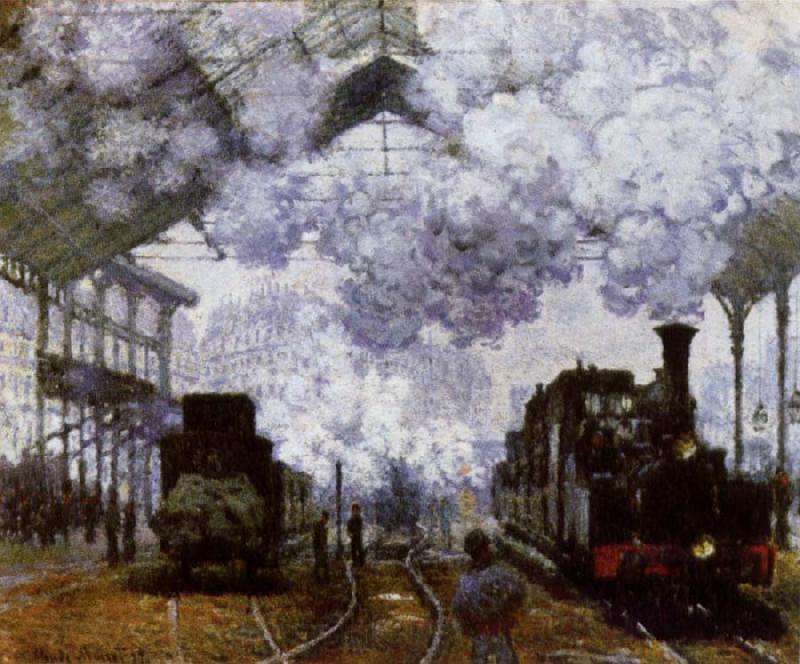
Claude Monet: Gare Saint Lazare, 1877


The years turn and turn, slowly at first, like the wheels of a train as they roll from the station. Bit by bit, momentum gathers. In the window, scenery starts to flicker and flit. We catch glimpses of a gray mountain capped with snow, a shanty red barn long abandoned. The train hurtles by a lake so still that it casts an unearthly reflection of the heavens, and then it, too, is gone. Suddenly, the train lurches. It pulls up to a platform. We disembark. Behind the train, twin tracks of silver vanish in the distance. We’ve traveled far and traveled quickly. “It went by so fast,” we say.

But the tracks point the way back. We know the train’s path. We can retrace our steps and measure gain and loss, joy and ache. To search the past, though hard on the soul, is easy on the eyes. Hindsight is 20/20, we say. But what of the future? What of looking upon the tracks ahead — instead of those behind — and studying them like a travel guide before a journey? When we know what lies ahead, are there parts of life we savor more? Are there traps and pitfalls we might circumvent? 

This week’s Torah portion, Toldot, begins with a prophecy. Rebecca, after 20 years of unrequited prayer, is finally with child — twins in fact: Esau and Jacob. But the pregnancy is unbearable. “The children struggle together within her.” Fearing she may lose the pregnancy, she cries out: “If it be so, wherefore do I live?” (Genesis 25:22; Malbim’s Commentary).

The Lord responds to her outcry: “In your womb are two nations; two peoples shall your bowels disperse. One people shall be stronger than the other people; and the elder shall serve the younger” (Genesis 25:23). Although her fear of miscarriage is allayed, another anxiety dams her heart: How does one raise two siblings who already contend in the womb and whose own children will contend long after they die?

It comes as no surprise that Esau and Jacob are nothing alike. Esau is a wild bear of a man, “a cunning hunter in the fields.” Jacob is an “innocent” who prefers to “dwell among the homely tents.” Yet, what does surprise us is how Rebecca and Isaac raise their sons. Instead of trying to bridge their differences, they widen the chasm and add bitter spices to the boiling stew of strife. “Now Isaac loved Esau, because he ate of his venison; but Rebecca loved Jacob” (Genesis 25:28).

Rabbi Hezekiah ben Manoah, the medieval French commentator, points out that Isaac’s love was inconstant and conditional; he would express his approval of Esau in return for a helping of freshly hunted meat. In contrast, Rebecca’s love for Jacob was constant and unconditional, flowing to Jacob without preemption (Hizkuni on Genesis 25:28).

Atop favoritism and asymmetric love, there is the added sorrow for what each boy lacks. Jacob grows up longing for his father’s approval. Esau, on the other hand, is deprived the wholehearted love of his mother. Jealousies abound. Each train, it seems, has left the station, and the tracks are surely crossed.

Rabbi J.H. Hertz, the late U.K. chief rabbi, suggests that had Isaac and Rebecca raised their sons differently, spreading their love out more evenly, the whole saga of stolen birthrights and blessings may have been averted (Soncino, Genesis 25:28). But before we judge, we ought to ask ourselves if we are any better. When we think on the future, near and distant, can we, with a little effort, anticipate the mistakes we will undoubtedly make? Knowing our likes and dislikes, fears and faults, can we predict the pitfalls that will trip us up? And yet, though we know where the train tracks surely lead, how many of us still board the train, crowding the carriage with our lapses in judgment? 

Sometimes, though, we are afforded a second chance. The heart senses the wrongness of the way; the eyes search ahead and see what difficulties await. There is hope. Train wheels turn slowly at first; perhaps there is time to step back onto the platform.

Rabbi Yehuda Hausman is a Modern Orthodox rabbi who teaches in Los Angeles. He writes about the weekly parasha on his blog, rabbihausman.com

Thursday, November 10, 2011

Parashat Vayera: Young At Heart


James Tissot: Abraham's Counsel to Sarai circa: 1896-1902

‘And the Lord appeared unto him by the terebinths of Mamre, as he sat in the tent door in the heat of the day.’ (Genesis 18.1) 

It is not strange to find an old man, ninety-nine years of age, sitting at the entrance of a tent, soaking up the day’s heat. For such a man would appear to be resting. The midday siesta is an ancient custom still observed in many lands. All are entitled to a little respite from toil under the sun. Why should this man be any different? (Shadal on Gen. 18:1; II Samuel 4:5)

But this elderly man is no ordinary man, for he is our Patriarch Abraham—who left the substance and security of his native country for an elusive promise and an ethereal dream. Indeed, this is the husband of Sarah, the rescuer of Lot, the binder of Isaac, and the father of faith. Far be it to imagine such a man dozing in the middle of the day!

Naturally, some of our Sages taught otherwise. Abraham was not resting so much as recuperating, for he was circumcised just three days before. (Cf. Gen. 17:24) Thus God appears, so to speak, ‘to visit the infirmed.’ Moreover, the strange messengers that Abraham entertains in the opening scenes of this week’s portion may have been partly sent to distract Abraham from residual pain. (Rashi 18:1; Cf. Baba Metziah 86b)

Either way, what unfolds is as incongruous as snow in Los Angeles or dolphins with feathers and wings. Lifting his eyes and sighting these three strangers in the distance, Abraham rouses himself from his afternoon lethargy, from the weariness of age, or from incapacitating pain….and he begins to run. He dashes toward these travelers to entice them with promises of wash-water, good food, and shade. He then races to the tent, to Sarah, and harries her with breathless instructions to make cakes. “Make ready, quickly, three measures of fine flour, knead it, and make cakes!” (Gen. 18:6)

It’s perhaps the funniest scene in Genesis…Sarah certainly knows how to make cakes! She is ninety years old. (There is little she doesn’t know.) But before Sarah can retort, Abraham has darted away and gone ‘running to slaughter a calf.’ (18:7)

Where does Abraham get the energy? How does a man of ninety-nine, flit and fly like a boy of nine? Never mind the incongruity of the very old acting like the very young—is Abraham’s behavior even possible?!  
Many rationalists of the Middle Ages argued that the entire episode of Abraham and the three messengers took place in a vision or dream. (Guide of the Perplexed II.42) Thus Abraham, the centenarian, never ran about like a kindergartener at recess; instead, what occurred took place in his mind’s eye, as ‘he dozed soundly in the afternoon sun.’ (Radak 18:1; Cf. Ibn-Kaspi  Num. 22:23)

Though rationalists have a habit of stripping religion of the otherworldly and the mythical—not always to our liking—in this case, the rationalists may have done us a service. For if dreams say anything about our souls, Abraham’s dream tells us that he is young at heart. He dreams himself running about in youthful exuberance, chiding his wife like a recent bridegroom in a new home. His bones may be weary, but his spirit races…his soul skips between the tents and terebinths of Mamre.

I leave you with a few words of W.B. Yeats:

An aged man is but a paltry thing,
A tattered coat upon a stick, unless
Soul clap its hand and sing, and louder sing…
(Sailing to Byzantium - 1928)

Thursday, October 6, 2011

Yom Kippur: Candles in Every Place

Portuguese Synagogue, Amsterdam

'Before Yom Kippur, we light candles in every place—within synagogues, study halls, dark passages and on account of the infirm.' – Rabbi Yosef Karo - Code of Jewish Law O.H. 310.3

The Day of Atonement is a day of introspection. The inner eye of critique is loosed upon the record of our deeds.  And the record is never good. The heart thunders:  ‘How have I wronged my fellowman!’ The lips whisper: ‘How have I wronged my Maker!’ Regret runs deep and swells like the sea.

But though it be a day devoted to reflection, and though we may be caught up in the tempestuous swirl of our own thoughts, Rabbi Yosef Karo reminds us that Yom Kippur is much more than that…it is a day not just for oneself, but for others as well.
Many, who rarely see the inside of a sanctuary, will come on Yom Kippur.  Of these, some will have difficulty seeing, hearing or following...and they’ll need light to find their way.  

So over the holiday, try to look up occasionally from one’s prayer book and search about you. To the left, there may be an unfamiliar face in want of reassurance. To the right, another searches aimlessly for the correct page. In the aisle, an elderly woman struggles to find her seat. By the entrance, a lone Jew stands for the first time in a sanctuary…afraid, but wanting to be drawn in.

There are many kinds of light that need kindling. Especially for Yom Kippur, we must light candles every place.
               
A Meaningful Fast.

A Poem: On the Eve of Yom Kippur

On the Eve of Yom Kippur

Autumn turns my thoughts to rain, to pebbled ice
To sins of late and sins of yore.
Each deed is but one brick of scarlet,
Together they make a wall of shame.

Exiled, I flee the wind
I hear not her voice drifting.
I hide within the trees
Yet my heart is wet with searching.
I want summer, quiet and still,
But the twisting road is always the better story.
           
They say surrender is winter white—
Like the Day of Atonement
Like Adam, on the day of his making
And later, his unmaking.
I stare at the sky, not white or grey,
The setting sun is the color of war.