Search This Blog

Thursday, November 24, 2011

Parashat Toldot: A Collision of Fate

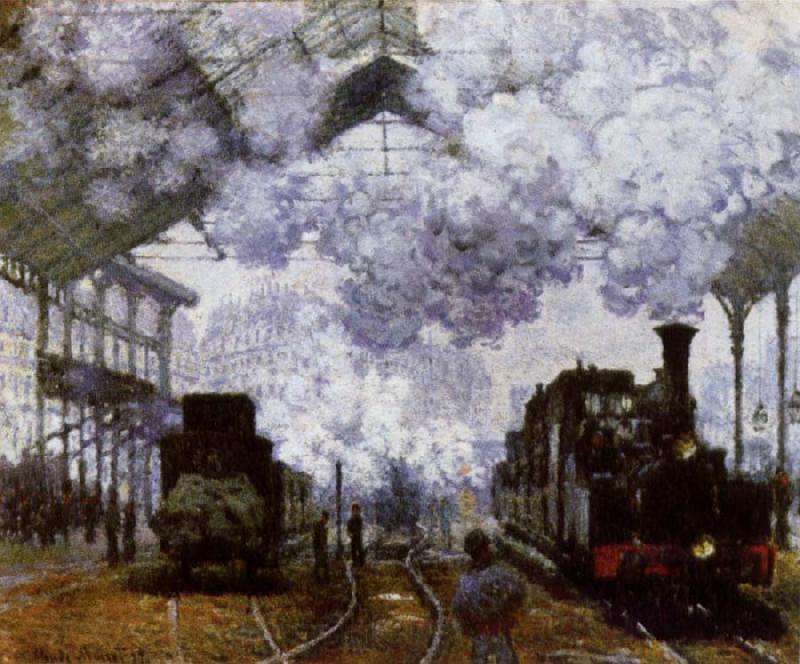
Claude Monet: Gare Saint Lazare, 1877


The years turn and turn, slowly at first, like the wheels of a train as they roll from the station. Bit by bit, momentum gathers. In the window, scenery starts to flicker and flit. We catch glimpses of a gray mountain capped with snow, a shanty red barn long abandoned. The train hurtles by a lake so still that it casts an unearthly reflection of the heavens, and then it, too, is gone. Suddenly, the train lurches. It pulls up to a platform. We disembark. Behind the train, twin tracks of silver vanish in the distance. We’ve traveled far and traveled quickly. “It went by so fast,” we say.

But the tracks point the way back. We know the train’s path. We can retrace our steps and measure gain and loss, joy and ache. To search the past, though hard on the soul, is easy on the eyes. Hindsight is 20/20, we say. But what of the future? What of looking upon the tracks ahead — instead of those behind — and studying them like a travel guide before a journey? When we know what lies ahead, are there parts of life we savor more? Are there traps and pitfalls we might circumvent? 

This week’s Torah portion, Toldot, begins with a prophecy. Rebecca, after 20 years of unrequited prayer, is finally with child — twins in fact: Esau and Jacob. But the pregnancy is unbearable. “The children struggle together within her.” Fearing she may lose the pregnancy, she cries out: “If it be so, wherefore do I live?” (Genesis 25:22; Malbim’s Commentary).

The Lord responds to her outcry: “In your womb are two nations; two peoples shall your bowels disperse. One people shall be stronger than the other people; and the elder shall serve the younger” (Genesis 25:23). Although her fear of miscarriage is allayed, another anxiety dams her heart: How does one raise two siblings who already contend in the womb and whose own children will contend long after they die?

It comes as no surprise that Esau and Jacob are nothing alike. Esau is a wild bear of a man, “a cunning hunter in the fields.” Jacob is an “innocent” who prefers to “dwell among the homely tents.” Yet, what does surprise us is how Rebecca and Isaac raise their sons. Instead of trying to bridge their differences, they widen the chasm and add bitter spices to the boiling stew of strife. “Now Isaac loved Esau, because he ate of his venison; but Rebecca loved Jacob” (Genesis 25:28).

Rabbi Hezekiah ben Manoah, the medieval French commentator, points out that Isaac’s love was inconstant and conditional; he would express his approval of Esau in return for a helping of freshly hunted meat. In contrast, Rebecca’s love for Jacob was constant and unconditional, flowing to Jacob without preemption (Hizkuni on Genesis 25:28).

Atop favoritism and asymmetric love, there is the added sorrow for what each boy lacks. Jacob grows up longing for his father’s approval. Esau, on the other hand, is deprived the wholehearted love of his mother. Jealousies abound. Each train, it seems, has left the station, and the tracks are surely crossed.

Rabbi J.H. Hertz, the late U.K. chief rabbi, suggests that had Isaac and Rebecca raised their sons differently, spreading their love out more evenly, the whole saga of stolen birthrights and blessings may have been averted (Soncino, Genesis 25:28). But before we judge, we ought to ask ourselves if we are any better. When we think on the future, near and distant, can we, with a little effort, anticipate the mistakes we will undoubtedly make? Knowing our likes and dislikes, fears and faults, can we predict the pitfalls that will trip us up? And yet, though we know where the train tracks surely lead, how many of us still board the train, crowding the carriage with our lapses in judgment? 

Sometimes, though, we are afforded a second chance. The heart senses the wrongness of the way; the eyes search ahead and see what difficulties await. There is hope. Train wheels turn slowly at first; perhaps there is time to step back onto the platform.

Rabbi Yehuda Hausman is a Modern Orthodox rabbi who teaches in Los Angeles. He writes about the weekly parasha on his blog, rabbihausman.com

Thursday, November 10, 2011

Parashat Vayera: Young At Heart


James Tissot: Abraham's Counsel to Sarai circa: 1896-1902

‘And the Lord appeared unto him by the terebinths of Mamre, as he sat in the tent door in the heat of the day.’ (Genesis 18.1) 

It is not strange to find an old man, ninety-nine years of age, sitting at the entrance of a tent, soaking up the day’s heat. For such a man would appear to be resting. The midday siesta is an ancient custom still observed in many lands. All are entitled to a little respite from toil under the sun. Why should this man be any different? (Shadal on Gen. 18:1; II Samuel 4:5)

But this elderly man is no ordinary man, for he is our Patriarch Abraham—who left the substance and security of his native country for an elusive promise and an ethereal dream. Indeed, this is the husband of Sarah, the rescuer of Lot, the binder of Isaac, and the father of faith. Far be it to imagine such a man dozing in the middle of the day!

Naturally, some of our Sages taught otherwise. Abraham was not resting so much as recuperating, for he was circumcised just three days before. (Cf. Gen. 17:24) Thus God appears, so to speak, ‘to visit the infirmed.’ Moreover, the strange messengers that Abraham entertains in the opening scenes of this week’s portion may have been partly sent to distract Abraham from residual pain. (Rashi 18:1; Cf. Baba Metziah 86b)

Either way, what unfolds is as incongruous as snow in Los Angeles or dolphins with feathers and wings. Lifting his eyes and sighting these three strangers in the distance, Abraham rouses himself from his afternoon lethargy, from the weariness of age, or from incapacitating pain….and he begins to run. He dashes toward these travelers to entice them with promises of wash-water, good food, and shade. He then races to the tent, to Sarah, and harries her with breathless instructions to make cakes. “Make ready, quickly, three measures of fine flour, knead it, and make cakes!” (Gen. 18:6)

It’s perhaps the funniest scene in Genesis…Sarah certainly knows how to make cakes! She is ninety years old. (There is little she doesn’t know.) But before Sarah can retort, Abraham has darted away and gone ‘running to slaughter a calf.’ (18:7)

Where does Abraham get the energy? How does a man of ninety-nine, flit and fly like a boy of nine? Never mind the incongruity of the very old acting like the very young—is Abraham’s behavior even possible?!  
Many rationalists of the Middle Ages argued that the entire episode of Abraham and the three messengers took place in a vision or dream. (Guide of the Perplexed II.42) Thus Abraham, the centenarian, never ran about like a kindergartener at recess; instead, what occurred took place in his mind’s eye, as ‘he dozed soundly in the afternoon sun.’ (Radak 18:1; Cf. Ibn-Kaspi  Num. 22:23)

Though rationalists have a habit of stripping religion of the otherworldly and the mythical—not always to our liking—in this case, the rationalists may have done us a service. For if dreams say anything about our souls, Abraham’s dream tells us that he is young at heart. He dreams himself running about in youthful exuberance, chiding his wife like a recent bridegroom in a new home. His bones may be weary, but his spirit races…his soul skips between the tents and terebinths of Mamre.

I leave you with a few words of W.B. Yeats:

An aged man is but a paltry thing,
A tattered coat upon a stick, unless
Soul clap its hand and sing, and louder sing…
(Sailing to Byzantium - 1928)

Thursday, October 6, 2011

Yom Kippur: Candles in Every Place

Portuguese Synagogue, Amsterdam

'Before Yom Kippur, we light candles in every place—within synagogues, study halls, dark passages and on account of the infirm.' – Rabbi Yosef Karo - Code of Jewish Law O.H. 310.3

The Day of Atonement is a day of introspection. The inner eye of critique is loosed upon the record of our deeds.  And the record is never good. The heart thunders:  ‘How have I wronged my fellowman!’ The lips whisper: ‘How have I wronged my Maker!’ Regret runs deep and swells like the sea.

But though it be a day devoted to reflection, and though we may be caught up in the tempestuous swirl of our own thoughts, Rabbi Yosef Karo reminds us that Yom Kippur is much more than that…it is a day not just for oneself, but for others as well.
Many, who rarely see the inside of a sanctuary, will come on Yom Kippur.  Of these, some will have difficulty seeing, hearing or following...and they’ll need light to find their way.  

So over the holiday, try to look up occasionally from one’s prayer book and search about you. To the left, there may be an unfamiliar face in want of reassurance. To the right, another searches aimlessly for the correct page. In the aisle, an elderly woman struggles to find her seat. By the entrance, a lone Jew stands for the first time in a sanctuary…afraid, but wanting to be drawn in.

There are many kinds of light that need kindling. Especially for Yom Kippur, we must light candles every place.
               
A Meaningful Fast.

A Poem: On the Eve of Yom Kippur

On the Eve of Yom Kippur

Autumn turns my thoughts to rain, to pebbled ice
To sins of late and sins of yore.
Each deed is but one brick of scarlet,
Together they make a wall of shame.

Exiled, I flee the wind
I hear not her voice drifting.
I hide within the trees
Yet my heart is wet with searching.
I want summer, quiet and still,
But the twisting road is always the better story.
           
They say surrender is winter white—
Like the Day of Atonement
Like Adam, on the day of his making
And later, his unmaking.
I stare at the sky, not white or grey,
The setting sun is the color of war.


Friday, September 23, 2011

Parashat Nitzavim-Vayelech: Lost and Found


Just thirty minutes outside of Baltimore, there are dozens of smooth country roads that flow like rivers between banks of undulating forest.  As my wife and I coasted past rolling hills of green, we had the impression of driving over waves.  Red barns and silver silos stood guard upon billowing crests while small ponds and brooks flowed through steep troughs.

Here and there, we found meadows picketed by wooden fences. Some were glazed recently with white paint, other fences were the color of smoke, the paint long peeled, the wood weathered and decayed. Beyond the fences, cattle grazed on tall grass.  There was one breed that had short wooly hair growing in patches of charcoal and ivory. Another breed had a coat that was cherry-brown and leathery like a chestnut horse.  We passed a long slope of trees that stretched like a cat into the distance, an endless forest of red maple, scarlet oak, hickory, white pine…. This being late September, scattered flecks of gold and red had begun to emerge like stars amid a velvet canopy of green. They were the first touches of the sunset we call ‘autumn.’

Yet as we drove, a polite but peaky robotic voice interrupted this visual feast with careful instructions. The voice belonged to my cellular phone. “Take next right in half a mile...Bear left at fork in-the-road…Continue straight toward destination…” As our eyes were lost in the scenery below, the phone’s navigational program guided us via satellites found high above. Though the convergence of Mother Nature and high technology was rather jarring, had we ignored the guiding voice, we would have been doubly lost in those trees, and we would have never arrived at our destination.

The one flaw of the navigation program was that each time I took a wrong turn or came upon a road that was not on one of its maps, the voice would suddenly announce: “recalculating…recalculating….” We would then wait anxiously for the phone to regain its bearings, to set a new course, to give us new directions. One time, however, the phone failed to find its way.  As the minutes slowly passed, and no new course was forthcoming, we began to worry. It felt strangely as if it too were lost—perhaps just as lost as we were....

In this week’s double Torah readings, Nitzavim-Vayelech, we find a prophetic vision of Israel’s repentance and return. Amidst our preparations for the coming High Holidays, the passage is thematically apt. “Then you shall turn to the Lord your God, and hearken to his voice…you and your children, with all your heart and all your soul. Then the Lord your God will return your captivity, and have compassion upon you, and will return you from among the peoples…” (Deut. 30:2,3)

Some understand the phrase “the Lord your God will return your captivity” to mean that God will change your fortune, restore you as in days of old. (Shadal; Cf. Jeremiah29.14; 39.25) Yet the Sages of the Talmud rendered the expression differently: ‘The Lord your God shall return with your captivity.’ As if to say, when Israel went into exile, God went along for the ride and remained banished, so to speak, till Israel’s long-awaited repentance and return. (Megillah 29a; Cf. Torah Temima and Rashi Deut. 30.3)

There is something quite startling about this image of God, exiled among the exiled, adrift and suffering by our side. For it implies that when we turn astray, God turns with us. And when we are lost, so too is God. One wonders if somewhere a small thin voice is crying out desperately, ‘recalculating… recalculating…’

When the navigation voice finally returned, it did so after I had done something that hearkened back to days of old.... I looked at the road, at the signs, at the sun, and then calculated which way was east and west and north and south, till I situated myself. Then I chose a road that seemed to head in the right direction. Immediately the voice returned: “continue straight toward destination.”

We were both found.

Shabbat Shalom

Friday, September 9, 2011

Ki Tetzeh: The Plight of the Captured Woman


In the ancient Greek city-state of Sparta, boys were required to keep their hair short in youth, then, as they reached maturity, they were permitted to grow their hair long as a symbol of strength and virility. Indeed, Plutarch records that Spartan warriors would "curl and adorn their hair" in preparation for battle, "as a fine set of hair would make the handsome more beautiful and the ugly more terrible." (Lycurgus 22) 

In contrast, Spartan women, young and old, kept their hair long, the exception being a bride on her wedding day. In Spartan tradition, the bride was first "kidnapped" by her husband-to-be, who would leave her in the hands of a bridesmaid. The bridesmaid would then clip her hair short so she resembled a boy. Shorn of this symbol of masculinity and martial power - not to mention femininity - she awaited the groom in the bridal-chamber. (Lycurgus 15.3; cf. Mortals and Immortals; Off with her head!) If there was any good in this horrid ritual, it may have been to remind the groom that his bride was not an adversary on the field of battle to be conquered or defeated. Yet this lesson came at a terrible price. For a Spartan man to learn to eschew violence in the bedroom, a young woman had to be robbed of her locks of womanhood and humiliated on the day of her wedding. 

In this week's portion, Ki Tetzeh, we find a number of biblical laws that are quite disturbing to modern sensibilities. Perhaps most disconcerting of all are the martial laws that relate to the captured woman. The Torah begins matter-of-factly: "When you go to war...and see among the captives a woman of beauty whom you desire and wish to take for a wife." (Deut. 21.10,11) It then prescribes a series of rituals that must be done before the Israelite man can marry her. "You shall bring her inside your home, where she shall shave her head, and let her nails grow..." She is then given “a month to weep and mourn for her mother and father.” If at this point, the man still desires to marry her, he may do so, and if not, he must set her free. (21.13-14)

Rabbi Bachya ben Asher notes that the purpose of these rituals is to make the captive woman less attractive; thus the shorn hair, unkept nails, and month of mourning. Moreover he adds that the enduring sight of the captive woman "weeping and pained" is intended to stir within the man a sense of compassion so that he is moved to give her freedom. (Commenting on vs. 21.13) To put it starkly, having suffered war, the loss of her family, capture, and possibly rape, the captive woman was made to undergo further humiliations just so that her captor could develop enough empathy to set her free. Such was the emotional obtuseness of men, even Israelite men, of that age. 

In a similar vein, we later find the Torah explaining why a victim of rape is innocent of blame. "But unto the damsel thou shalt do nothing; there is in the damsel no sin worthy of death; for as when a man rises against his neighbor, and slays him, even so is this matter." (Deut. 22.26) Already in Talmudic times, the sages wondered what need was there to to say that a victim of rape is as blameless as a victim of murder. Surely, that was and should be obvious! (Cf. Sanhedrin 74a) However, if one considers the mores of 9th century BCE Sparta, the common practices of war three millenia ago, or even the "honor killings" that we hear of today, the concept of a "blameless rape victim" requires education, for it was not obvious to men of that time and the point is still too often missed by many a man today.


To return to the plight of the captive woman and her stiff-hearted captor.... Though repugnant to us, there is an enduring lesson in psychology that is contained in the process by which the captor is finally led to empathize with his captive. Anyone who has fought heatedly with a friend or a loved one knows how easy it is to forget the damage of hurtful words. Ill remarks and thoughtless insults are flung unabated until one sees in the eyes of the other the sting of hurt or tears of pain. 


It is an unfortunate flaw of human nature that we are often blind to the pain we cause until we see some outer sign of damage and humiliation. It should not be so. Better if long before the senseless quip is loosed on kin or fellow, we ask ourselves how it would feel if the arrow were shot in one's direction.

Shabbat Shalom