Search This Blog

Thursday, October 30, 2014

Parashat Lech Lecha: In a Dark Time

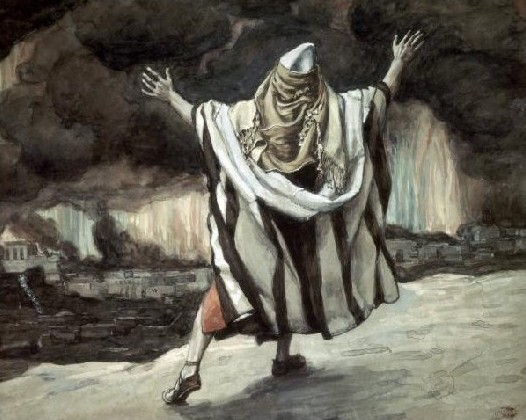
Abraham Sees Sodom in Flames - James Tissot

 And the Lord God formed man from the dust of the earth and blew into his nostrils the breath of life.’ -Genesis 2:7

He was a mound of mud. Just another fold of earth indistinguishable from his surroundings. From the earth he was taken, and to earth he would return. But now he lay there, his back pressed against the soil. If this were the grave, his face would have been cold and ashen, his eyelids sealed forever. But here was a man awoken. Here was a beating heart. Here was a beginning not an end.

Adam opened his eyes: open, shut, open. Night faded. Morning drew away dawn’s breath. The mist departed. No longer was this a mound of mud, but a man alive. On his back, Adam gazed skyward. Imagine his first glimpse as the vault of heaven filled his eyes…. What a testament to human nature! Between the first kicks in the womb and the repose of the grave — the sky is the limit. Half beast half seraph, Adam lay there between sleeping and flying.

A favorite poet, Theodore Roethke once wrote: “What is madness but nobility of soul at odds with circumstance?”[1] In all the Bible, there is perhaps no soul more noble than that of Abraham our father. His every action is at odds with circumstance, his very faith at odds with an entire world. Every friend became a doubter. ‘Where are you going Abraham? You leave your country, your birthplace, you dare abandon your father’s home! This is madness, Abraham. Who is this unheard-of-God that you claim to hear? What God says “go to some place which I will show you?” If He can make heaven and earth, why does this place not have a name?’ Where are you Abraham? Where?’

“A man goes far to find out what he is—,” wrote Roethke. In Abraham’s case, very far indeed. From the great plains of Mesopotamia, westward to Assyria, south to Canaan than down to Egypt and back again. “Traveling continually...,” the Torah records, but always “to the place that I will show thee.”

It was a dark world, few were kind to strangers. Not the Pharaoh of Egypt who kidnapped Sarah, or the Philistines on the coast, who did the same. His nephew Lot departs after a dispute over flocks and pasturage. An unspoken rebuke. Abraham abandoned family once, now family abandons him.

We have heard this story more than once. The people of Sodom were neither kind nor generous. Yet when a near fist of kings sacks their city taking property and people alike (including Lot), Abraham plots a rescue. His audacity is foolish. His courage military folly. 318 men against the might of four kings. But Abraham is successful. He wages war, his enemy retreats. When offered spoil, he takes not a ‘shoelace’ for himself. (14.23) People and property are returned to the king of Sodom. An altruistic war, fought purely on behalf of others. And think of these others, Sodom, who denied guest-right to guests, who later sought to humiliate Lot and his household for treating strangers with dignity and respect. The city’s evil rises up before the Lord, which God overturns in brimstone and fire. Yet Abraham’s compassion extends even to wrongdoers, enemies of the very way of life he holds dear. Was this nobility or madness?

Which I is I? Roethke asks. Even Abraham has doubts. He and Sarah are advanced in age, without natural heir. “Shall Eliezer of Damascus inherit me?” asks Abraham of God. How long can a man live in clouds which never rain?

“In a dark time the eye begins to see,” wrote Roethke. Out of the depths, a voice emerges. “Then the Lord’s word came to Abraham in a vision, ‘Be not afraid Abram…your reward is exceedingly great.’” ‘Come outside Abraham. “Pray look toward the heavens and count the stars, can you count them?”’ (Gen. 15.5)

Rabbi Judah opined in the Talmud that when Adam was first created his body stretched from one end of the earth to the other. (Sanhedrin 38b) No earthly power could contain him. It was only after his disobedience that man was shrunk to his present size. But in Abraham, God found something of the Adam He had first conceived; A man who saw the infinite in the imminent: “And Abraham lifted up his eyes and saw the place from afar” (Gen. 22.4) Here stood a man who thought not of scaling the mountain, but of scaling the clouds above. (Rashi ibid) “Can you count the stars? So shall your seed be.” 

We know nothing till we try. Every heart has its doubts. We dream dreams but then tell ourselves: 'It is too much, it is too late.'  Another great poet, Rainer Maria Rilke, lamented: “Everything is far / and long gone by.” But there is still time. Rilke writes: I would like to step out of my heart / and go walking beneath the enormous sky [2] 

Such was Adam when he first gazed above. Such was Abraham, a noble madman, who one desert night stepped outside his heart and walked with God beneath the sky, who listened to the stars whisper and heard in them the voices of a nation that would number as the sand. 

Wednesday, October 22, 2014

Parashat Noah: Out of the Crooked Timber of Humanity

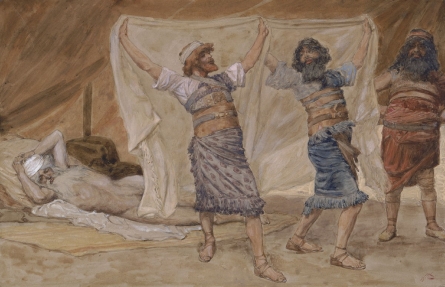
Noah's Drunkeness - James Tissot, 1896-1902 

Prior to the flood we are told that "the Lord saw the wickedness of man upon the earth, how every form of his heart's devising was for evil, only and always" (Gen. 6:5).  But then in its aftermath, after God promises never again to drown the earth, the Lord declares "for that which the human heart forms is evil from its youth"  (8:21). A strange literary envelope. Humanity slouched toward evil beforehand, and slouched toward evil forever afterward, though in the interim an entire world was unmade and remade anew.  One may be forgiven for asking to what end was all this destruction? For what purpose did God blot out countless living-creatures, be they human or beast?  When all is said and done: 'The human heart schemes evil from its youth.' What changed?

There is a great deal that is repetitious in Genesis, more than several recurring themes and plots. To share a few examples. A close inspection of the story of Cain and Abel reveals hues and colors borrowed heavily from the scenery of Eden. In both stories, sin is instigated by fruit: the fruit of knowledge of good and bad and the fruit of the ground that Cain offers to God in tribute. In the Garden, sin is likened to a snake in the grass poised to 'bite at Eve's heel' (3:15). Likewise God says to Cain , 'If you do well, bear it (e.g. the burden of doing good); and if you do not well, sin crouches [like a beast] at the door" --akin a coiled serpent poised to strike its prey (Gen. 4:7).

Misdeed and disobedience in each story is followed by a divine interrogation. "Where are you? Who told you that you were naked?" These questions unmask Adam's heart. Yet the saddest question in all of Torah is directed toward Cain, "Where is Abel your brother?" We later read that the "earth is cursed" on account of Adam's sin, "...by the sweat of your brow shall you eat bread." So terrible is Cain's murder of his brother that God declares, "cursed be you from the earth...which will not henceforth give you its strength."

Adam and Eve are 'driven from the Garden' and settle somewhere to its East. (3.24) Fittingly, Cain complains "you drive me away this day from the face of the earth....later Cain settled in the land of Wandering (Nod), east of Eden" (4.12).

Adam began life in Paradise, eating fruit trees at his pleasure, and ends a farmer, with scythe and plough in hand. Cain begins a farmer and ends a scavenger, wandering the earth for wild fruit and berries. Cain has regressed to a life that is notably Eden-like for its apparent absence of responsibility, "my burden is too great to bear," he cries out (4.13). No spade or scythe are necessary for his new way of life. While all this is fascinating in detail, on a wider plane, what is the purpose of parallel language, why this literary return to Eden through the employment of recurring symbols and themes?

Another example. After Noah and his family disembark from their sunless cruise they settle down. "And Noah, a husbandman of the earth, began by planting a vineyard. He then drank from the wine and was drunk, and exposed himself in his tent" (9:20-21).  Here too the reds of Eden reappear. In Eden, there was a fruit and a tree, while with Noah we have grape and vine. Having imbibed of this fruit, Noah falls asleep in the nude, his grapes the cause of his nakedness. It falls upon Noah's sons, Shem and Yafeth to cover their somnolent father. Sound familiar? In the garden, the fruit of knowledge awakens Adam and Eve to their bare-skinned state. They sew themselves fig leaves in shame. Remarkably, both episodes end with damnations. As God cursed the earth for Adam's sins, Noah curses Ham (his son) and Canaan (his grandson) for having 'seen Noah's nakedness.'

The symmetry is striking. One one level, it conveys humanity's ever-terrible temptation of returning to an Eden-like way of life. Cain does not wish to be burdened with the human responsibility of doing good, e.g. sparing the brother who has caused him sorrow. "If you do well, carry the burden (se'et)." Cain further shirks responsibility for his crimes. "My iniquity is too great to bear." Noah, a survivor of apocalyptic destruction and death, imbibes to forget, to sleep, to return to that youthful -- less intellective -- state; a state embodied by the innocence of Eden, where man and woman ran about like unclothed children.

On a deeper level, the fact that the flood and exile do not change humanity's basic nature speak volumes about humanity's darkest crimes. Though our capacity to love and care is as deep as the sea, our penchant for evil is as wide as the ocean. There is no end to villains, terrorists, and despots. There is no accounting for the murders of one or the genocides of many. The flood in Noah's generation teaches a lesson that we have yet to internalize. Humanity is all-too deserving of destruction for its crimes.  In the words of the House of Shammai, "It would have been preferable for man to not have been created."

Yet God spares us each season, and each day of each year. "I will never again strike down all living-things, as I have done.... sowing and harvest, cold and heat, summer and winter, day and night, shall never again cease" (8:21-22). But having been spared, left alive like Adam, Eve and Cain, like Noah and his sons, what shall we do? Do we rise up and carry the responsibility of doing what is good and right? Just as importantly, when we do not well, how do we answer the questions, Where are you? Where is Abel your brother?  


Wednesday, October 15, 2014

Parashat Bereishit: Paradise Lost?

Long have there existed myths of eternal life. The Spanish explorer, Ponce de Leon, was said to have discovered a fountain of youth in the glades of Florida. Herodotus, the Greek historian, recounts the attributes of the Macrobians, a mythical people believed to reside on the horn of Africa, who possessed a restorative spring "with a scent like that of violets." Akin Israel, the religions of ancient Egypt and Persia also had their trees of life.

As an antidote to old age imbued with the promise of timeless youth, it is not difficult to understand the idea's popular appeal. But is the Tree of Life - real or allegorical - something to be sought out? Ought its absence from this world be counted a major loss to our quality of life?

When seeking out the cause for Adam and Eve's banishment from the Garden, our attention naturally drifts toward the 'tree of knowledge of good and bad.' John Milton sums up the matter: "Of man's first disobedience, and the fruit/Of that forbidden tree, whose mortal taste/Brought death into the world, and all our woe..." (Paradise Lost: The First Book)

True, eating of the tree of knowledge led to certain consequences, "in pain shall you rear children ....by the sweat of your brow shall you eat bread." But perhaps it is a mistake to hang all of the blame upon the branches of a single tree. With the chapter's conclusion we read: "And the Lord God said, the man has become like one of us, knowing good and bad, what if he should stretch out his hand and take also from the tree of life and eat, and live forever! So the Lord God banished him from the garden of Eden... (3:23)" Expulsion, according to Genesis, was not punitive it was preventative: lest Adam and Eve gain life eternal.

This is undoubtedly puzzling. Regarding the tree of knowledge, it was sufficient for God to warn woman and man not to eat. But for the tree of life, so determined is God that humanity not partake of its fruit that no choice is offered. What could possibly be so dangerous about a life unfettered by death?

It is always worth pointing out how much the garden narrative is full of dichotomies. Adam and Eve begin naked, but before they are driven away, the Lord God "clothes them in garments." In their innocence, they unabashedly eat of the tree, afterwards we read how they hid amidst "the tree of the garden" embarrassed and ashamed. Our slippery serpent is introduced as being "more clever than all the beasts of the field (3.1)" till God declares that he slither on the ground "more cursed than all the animals and beasts of the field. (3.14)" And so it goes.

One wonders, if in a way, the tree of knowledge and tree of life represent opposing polarities as well. Each perhaps embodies a contrasting temptation. While penned in Eden, in full possession of eternal life, humanity thirsted for experience. Elsewhere in the Bible, the expression "knowing good and bad," implies knowledge of all things on the earth. As in Deuteronomy 1.39: "your little children, who on this day, know not good or bad" - nothing, as it were. (Similarly, see II Sam. 14.17)

But to attain knowledge, there must exist distinctions and choice. Obedience cannot be appreciated unless man has some taste of the bitter fruit of disobedience. The satisfaction that comes with harvesting bread, raising children, is built on hard work and sacrifice. It is not just the 'tree of good and bad,' it is the tree of joy and sorrow, pain and pleasure, loss and gain, work and reward. Sensibly, woman and man needed to be cast out of the Garden lest they eat of the tree of life. It is only through an appreciation of mortality that one comes to value the miracle of a beating heart.

Nevertheless, just as humanity turns to its pursuit of knowledge, another temptation ripens enticingly to take its place. The tree of life embodies our appetite for Eden, a utopia that requires neither labor nor sacrifice, a paradise where all food grows on trees without human assistance. (2.9) Who among us has not harbored some secret desire to live a life absent hardship or pain? What human has never wished to bury the hollow despair that accompanies loss? Would not ignorance and bliss be preferable to the knowing shame that accompanies wrongdoing and error? In a culture that worships youth, who has not dreamed of some elixir that defies death, some balm that vanishes age?

If eating the tree of knowledge made us human, eating from the tree of life would rob us of our very nature. There is no life without death, no good without bad. To eat of the fruit of life, would mean no life at all. "And so [the Lord] drove man out, and stationed Cherubim to the east of the garden of Eden, and the bright blade of a revolving sword, to guard the way to the tree of life (3.24)."

Thursday, July 31, 2014

Parashat Devarim: Terror and The West

 From the Jewish Journal of Los Angeles:

Terror and the West
By Rabbi Yehuda M. Hausman
Parashat Devarim (Deuteronomy 1:1-3:22)

And the Lord God said to the Serpent: Because you did this, cursed be you of all the cattle and all the beasts of the field. On your belly shall you go, and dust shall you eat all the days of your life. Enmity will I set between you and the woman, between your seed and hers. He will crush your head, and you will strike his heel (Genesis 3:14-15).

The Lord does not bother to interrogate the Serpent. With man and woman, there are motives to divulge, designs to ferret out: "Where are you?" "What have you done?" "Did you eat from the tree?"

When shamed, man will cloak himself in fig leaves and hide behind hydrangeas. Such is the crooked timber of humanity, one must peel away each subterfuge, strip back each layer of evasion to get at the truth. A snake, on the other hand, just watch and wait, it will always shed its skin.

Allegorically, the Serpent is humanity's penchant for evil. Of it, what is there to ascertain? As surely as a stomach lusts for food, evil craves man's heart. It can make no excuses. It exists for its own sake. Even diminished — without legs, claws or cleverness — it still crouches at the door, poisoned fangs ready to strike. "Its desire is for you," so Cain is warned. Once unleashed, its venom marks him forever.

Even still, we wish to hide from it. "My punishment is too great to bear," Cain cries out. Better to flee, to become “a nomad and a wanderer” than to face the evil in our midst. (Genesis 4:13-14)

This Shabbat, amidst a war in Israel and relentless turmoil around the globe, we begin Deuteronomy, the fifth book of the Torah. After 40 years of rootless travel, the Children of Israel are on the cusp of a long sought dream. Yet as Israel looks expectantly toward its future conquest in the West, the gaze of Moses is locked firmly on the past. His opening words contain no claim of triumph or call to arms, rather Moses’ recollection of history is littered with Israel’s many failures … “your trouble, your burden, your disputing” (Deuteronomy 1:12).

Alongside battles won and lost, recountings of journeys and encampments, Moses does not obviate from mentioning Israel’s grumblings and complaints. He persistently refers to how Israel “rebelled against the word of God” (Deuteronomy 1:43). Of Moses, we are later told that even on his dying day “his eye did not dim nor was his energy spent” (Deuteronomy 34:7). Moses was of unclouded sight and unwavering conviction.

This past year or so, the West has fallen to an awful nadir. Our sight has dimmed, our strength has seemingly depleted. We stare into the Serpent's clouded eyes, and instead of crushing its head, we turn heel in fear of its bite.

Not too long ago, Syria’s Assad was on the verge of collapse; a few more rifles and a few aerial attacks and his regime would have folded. Instead his militias were given respite while we averted our eyes from the death and displacement of hundreds of thousands.

We were relieved to finally leave Iraq, and have since watched (or not) the Islamic State of Iraq and Syria (ISIS) rise up and massacre Shiites, Christians, and Kurds.

Ongoing sanctions of Iran may as well be pardons for the all difference they make. We seem destined to follow a similar course with Russia. What might Putin do next if Europe does not have the nerve to act? We speak much, do little and look elsewhere at first opportunity.
  
Observing Israel these terrible last few weeks, it is plain that Israel has been remiss for quite some time. As we hid behind our Iron Dome, our F-16s and drones, a warren of evil entrenched itself under Gaza, its tentacles burrowing deeper and deeper into the Holy Land.  Unbeknownst to us, a den of vipers became a kingdom of cobras.

Is it too much to assume that if we had watched better, understood what simmered beneath, acted sooner, fewer soldiers would return home draped in Israeli flags? Could it be said that more vigilance might have prevented much of the death and decimation we are forced to witness each day?

Next week we observe the 9th of Av, in memorium of our two fallen Temples, and the many tragedies that have befallen Israel at the hands of our enemies. On this day, we do not avert our gaze from the past, but look on it truly.

“Inquire, pray, of past days, which were before you,” Moses instructs us. (Deuteronomy 4:32) Learn from the past, or be doomed to repeat it.

“The wicked flee when none pursueth,” so goes the proverb. There is a profound lesson the world needs to learn from Hamas: ‘Flee the serpent, and it will follow.’ 

Rabbi Yehuda M. Hausman is the spiritual leader of the The Shul on Duxbury, an independent Orthodox minyan. He is a teacher at the Academy for Jewish Religion, CA, and a lecturer at American Jewish University’s Ziegler School of Rabbinical Studies. He writes about the weekly parasha on his blog, rabbihausman.com.

Thursday, March 20, 2014

Parashat Shemini: The God of Winter

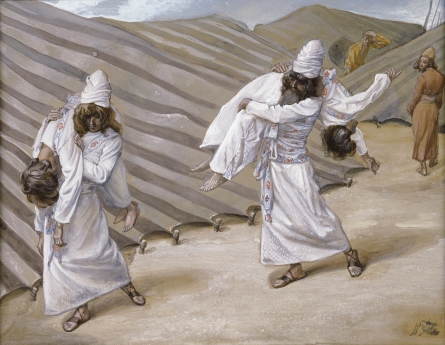
James Tissot: The Dead Bodies Carried Away (c. 1896-1902)

Parashat Shemini: The God of Winter
Rabbi Yehuda Hausman

A winter’s sun can give off much light but little warmth. The day may be radiant with bright snow and brilliant sky, but still we plod along with our shoulders pinched, teeth clenched, gloved hands buried deep in our pockets. Holiness can often feel like the sun in December, akin a menorah, we seem not meant to benefit but to ache for its light and, more so, its heat.

It is evident from this week’s Torah portion that Nadav and Avihu must have pined for holiness. It was not enough that they were priests and thus they ranked among the elders of Israel (Lev. 9.1). It did not suffice that they assisted their father, Aaron the High Priest, on the sacred day of the Tabernacle’s inauguration. From the beginning of the Torah portion, we are told pointedly and repeatedly of their full participation on that auspicious day. ‘They brought the blood… and delivered to Aaron the burnt offering...’ (Lev. 9.1,8-20). Still they yearned to draw closer. So the sons of Aaron, “took each his censer, and placed in them fire and laid incense upon it; and they brought-near alien fire before the Lord” (Lev. 10.1).

What happens next is strange on many counts. “And there came forth fire from before the Lord, and consumed them, so they died before the Lord” (10.2) It is not clear if this fire comes down from heaven, or emerges from the Holy of Holies. What is clear is that this second fire differs drastically from the first fire mentioned just a few verses above: “A fire went out from before the Lord to consume upon the altar the burnt-offering and fats” (9.24). This first flame contained heat, so much heat, that the day’s offerings, which had been roasting slowly on the altar’s normal flames, were consumed in an instant (R. Dovid Tzvi Hoffman).

In contrast, the flames that consume Aaron’s sons contain no heat. Each soul is devoured but it is a fire that leaves flesh and garments intact. Moses instructs two Levite cousins to remove the bodies from the Sanctuary, “So they drew near, and carried them by their tunics out of the camp” (10:5). There is no singed garments or seared skin. (See Rashi.) The tragic turn of events drips with irony. Aaron’s sons sought unsanctioned fire to “warm” themselves; measure-for-measure, the fire that took them was devoid of any heat.

If we consider the nature of holiness in the Torah, it consistently suggests hierarchy and degradations, the further away we stand the less intense the flame. God descends to Mt. Sinai in fire (Ex. 19.18). Someway down the mountain, Moses stands between God and the Elders, the Elders, in turn, stand between Moses and Israel, and the camp of Israel forms a boundary between the Mountain and mankind. The Sanctuary is no different. There is a courtyard around God’s dwelling place. The Levites encircle the courtyard and Tent of Meeting. The Israelite camp forms a ring around the Levites, and around Israel, there dwells the great mass of humanity. In our day, we think of the hierarchy as ‘Temple, Jerusalem, Promised Land, and Diaspora.’ But even the animal kingdom is divvied up in Leviticus. All of humanity can enjoy every kind of fish or fowl, critter or quadruped. But judging by the list rendered at the end of Parashat Shemini, only a tenth of those can be eaten by Israel, and of that tenth only a small portion is rendered fit as a sacrifice before the Lord. Clearly, proximity would mean a great deal, as God’s aura emanates from a central place. But before we conclude thus, consider Nadav and Avihu, who even before the presence of the Lord felt a sort of chill.

Such may be the strange fire of Godliness, near yet apart; the bush burns but does not burn; once, Israel experienced a fire upon the mountain, but the mountain was not ablaze. Long ago, there was an eight-day miracle, the wicks drew oil, formed teardrop flames, hour-upon-hour passed, but the wicks were not consumed.

If one message may be derived from our studies, perhaps it is this. We can only prepare ourselves for holiness, akin the Israelites who cleansed themselves, in body and spirit, before Revelation; or through careful ritual, as the priests and people performed before the Sanctuary’s Inauguration. In the meanwhile, till that bright light suddenly erupts in warmth, there is only the longing, as winter waits for spring.

Thursday, February 20, 2014

Parshat Vayakhel: The Spirit of Industry

 James Tissot: Building the Ark 
[Yes Noah's.]


Parashat Vayakhel: The Spirit of Industry
Rabbi Yehuda Hausman

Has it just vanished in smoke: l’esprit du temps? Several thousand years is a vast patch of history, perhaps in the interim, the novelty of a desert Sanctuary has simply seeped away. All its glory and wondrous color faded and stonewashed like an old beach-towel; its imminence lost on us, far more, in fact, than last week’s paper left to yellow in the sun. The Sanctuary’s time is not our time or our great-grandparents’ time. What chance is there that this Sanctuary can stir our hearts as in days of old?  
Admittedly, the descriptions are pleasant enough:  A portable gilded ark, crowned with cherubs; embroidered winged-sphinxes sewn into expensive curtains made of fine goat hair, perhaps a variety of Mohair or Cashmere, if we think on it. There are silver loops and clasps connecting this and that; an indoor altar and an outdoor altar; a golden candelabrum, and a great deal more.
But no amount of familiarity with the text seems to alter its foreignness. Imagine having to describe a spirited summer in Paris to someone who has never sat in a Café, or seen the inside of an art gallery, or fallen in love. The Louvre is nothing but a U-shaped palace, the Seine just another river; the scope of l’Arc de triomphe never quite translates if one has never spent ten minutes walking around its wide roundabout. Thankfully, the Torah has a way of easing us into the unfamiliar, even when most paths are shut; there is always another point of entrée.
One of the stranger aspects of the Tabernacle is that transmission of its many details is twice juxtaposed with the law of Shabbat. The initial five and-a-half chapters of Tabernacle blueprints culminate in a reminder to ‘guard the Sabbath by refraining from prohibited labor—malacha’ (Ex. 25.1—31.12-17).   
Additionally, when the time comes for actual construction, this later section is introduced with yet another mention of Shabbat: ‘For six days shall labor be done, but on the seventh day, there shall be for you holiness, a Sabbath of solemn-rest to the Lord […] You shall kindle no fire throughout all your habitations on the Sabbath Day’ (Ex. 35.2-3).
               Our Sages find in the strange proximity of these two subjects a stern warning. ‘Despite God’s command, construction of the Sanctuary was to cease on the Sabbath.’ (Rashi, Sforno) Why, some might ask? Is it not all for God? Later in the Torah Portion, we read that the people have made and donated far more material than was necessary for the building of the Sanctuary. So much so that Moses announces: “‘Let neither man nor woman make any more work for the sanctuary.’ So the people were restrained from giving” (Ex. 36.6). The exuberance of ancient Israel captures humanity’s boundless desire to fashion and make. Creation never quite ends on its own, for things can always be made better…grander…different. Then there is the danger that mindful work evolves into mindless productivity. The philosopher Raoul Vaneigem had this to say, “In an industrial society which confuses work and productivity, the necessity of producing has always been an enemy of the desire to create.”  
Without Moses cry of ‘enough,’ what compels to pause from projects great and small alike, if not mandatory Sabbath? Strikingly, what is odd about the Sanctuary and the Sabbath is that they are both holy, yet they do no quite mix. Like two great magnets of the same polarity, holiness of rest and holiness of work, though infused with a sacred charge, nevertheless push one another away. The Sabbath prevents the Sanctuary from being refurbished each month, from being ever remodeled and expanded each year.
The old awe of the Sanctuary may not be felt as it ought to be, especially when the average home is a great deal bigger than the Tent of Meeting. But we know the satisfaction of successful human labor, whether it’s a simple well-made soup or seeing a skyscraper rise up and kiss the clouds. We can also appreciate the dangers of overwork, one-mindedness, Napoleonic obsession, where no palace is large enough, no monument tall enough.
It is something of interest that of the many labors needed to create the Tabernacle, only the making fire is explicitly mentioned in the beginning of Parashat Vayekhel: ‘You shall kindle no fire…on the Sabbath Day.’ Rabbi Ovadiah Sforno suggests that fire is so basic to human industry, that a great many other labors could not be performed without it. But I prefer to end with a line by the poet Theodore Roethke:

What lives again? Only a man of straw—
Yet straw can feed a fire to melt down stone.

Fire can forge temples and cities or usher in the Sabbath with its light, but if man’s industry is left to burn unchecked, it can turn a Tabernacle into a spectacle, the Sabbath into just another day of work, and even melt the stone Tablets that reside in the Ark of the Covenant.

Friday, February 14, 2014

Parashat Ki Tisa: The Covenant of the Calf


William de Brailes: The Israelites Worship the Golden Calf and Moses Breaks the Tablets (C. 1250)


By Rabbi Yehuda Hausman

If the word of God, in stone engraved, can crumble as easily as bread; if God’s voice, chiseled in rock, can shatter like a pitched dinner plate; if the children of Israel can cast off their heavenly covenant with a casualness not unlike the unclasping of an earring or a necklace; if it is all so easily dismissed, what chance is there for loyalty and faith, when weighed against the allure of a pot of gold, or the lustrous aura of a gilded calf?

The narrative of the molten calf is unique on account of its plethora of vivid images. Moses and God, high upon the mountain, are engaged in august discourse, while far below, the restless people, dance their way from anxiety to frivolity, from fear to wretched faithlessness. Somehow, Aaron becomes a harassed sort-of baby-sitter, longing for the sound of an engine in the driveway, his ear tilted in the hope of the sound of jingling keys outside the door, all while the children run amuck.  

First they want gods to lead them. Perhaps, Aaron wonders, they will settle for a single graven calf. The people desire sacrifices; perhaps the ‘construction of an altar’ will provide some delay.  They wish for merriment, so Aaron declares a night vigil, a final interlude for the people to reconsider or Moses to return and intercede: ‘Tomorrow, a feast to the Lord,” he says (Exodus 32:1-6).  We know what ensues.

However there is no image more vivid than Moses’ reaction as he spies his people making sport of all that he holds dear: “And it was when he neared the camp and saw the calf and the dancing, Moses’ anger burned, he threw the tablets from his hands and smashed them beneath the mountain” (Exodus 32:19).

We have journeyed with Moses, our teacher, as he led Israel from slavery to freedom, from the dry-bed of the Red Sea to the sloping mount of Revelation. His defeat now is palpable. There is wrath in his eyes, rage on his face. It is as if he has found some stranger in bed with his spouse. What use are words when the pain is physical? The covenant has already been smashed to pieces.

But quite possibly, wittingly or otherwise, Moses conveyed in rage what could not be conveyed in thunder and lightening, in the great columns of smoke and flame that accompanied the giving of the Ten Commandments. Perhaps what was missing in the fireworks was an essential lesson about the meaning of loyalty. In the moment when Moses’ anger mirrored God’s anger, the children of Israel began to see the thunder anew. Partnerships, covenants, trust … they flow both ways. The voice of God could only be engraved on stone, but it is the image of Moses’ burning rage that gets chiseled in Israel’s heart.  

The verse that follows compounds the lesson: Moses took the calf that they had made, burned it with fire, ground it to fine-powder, scattered it over the water and made the Israelites drink it (Exodus 32:20).

Moses appears to want Israel to “taste” what it has done. His people must ingest the concoction and savor its distastefulness. In this way, they may come to appreciate the foulness of the whole affair. Many commentators wonder: From what source was this water drawn? Some, including Torah translator and interpreter Robert Alter, suggest this was the water that Moses “miraculously provided for the people, which would be a compounding of irony.”

In a different vein, the 12th Century rabbi, Abraham ibn Ezra, points to Deuteronomy 9:21 where Moses states that he took the grounded dust of the calf and flung it into “the stream that came down from the mountain.” This was hardly any old wadi, it was the very stream that swept down from Sinai and sustained the camp.

Faithfulness has little meaning without some awareness of the repercussions of faithlessness. How disloyalty dissolves the bond of trust, how it pollutes the waters of love — human and divine. Faith is no paltry thing, because the memory of broken faith endures forever. Stone tablets shatter, and God’s voice is lost in the wind; perhaps more than anything else, it was the Golden Calf that sealed the covenant.


Rabbi Yehuda Hausman is the spiritual leader of the The Shul on Duxbury, an independent Orthodox minyan. He is a teacher at the Academy for Jewish Religion, CA, and a lecturer at American Jewish University’s Ziegler School of Rabbinical Studies. He writes about the weekly parasha on his blog, rabbihausman.com.